

Core conjugation tables plus deeper form search
Review six core conjugation tables and search sourced imperfect-subjunctive and participle-agreement forms for the exact form you encountered.
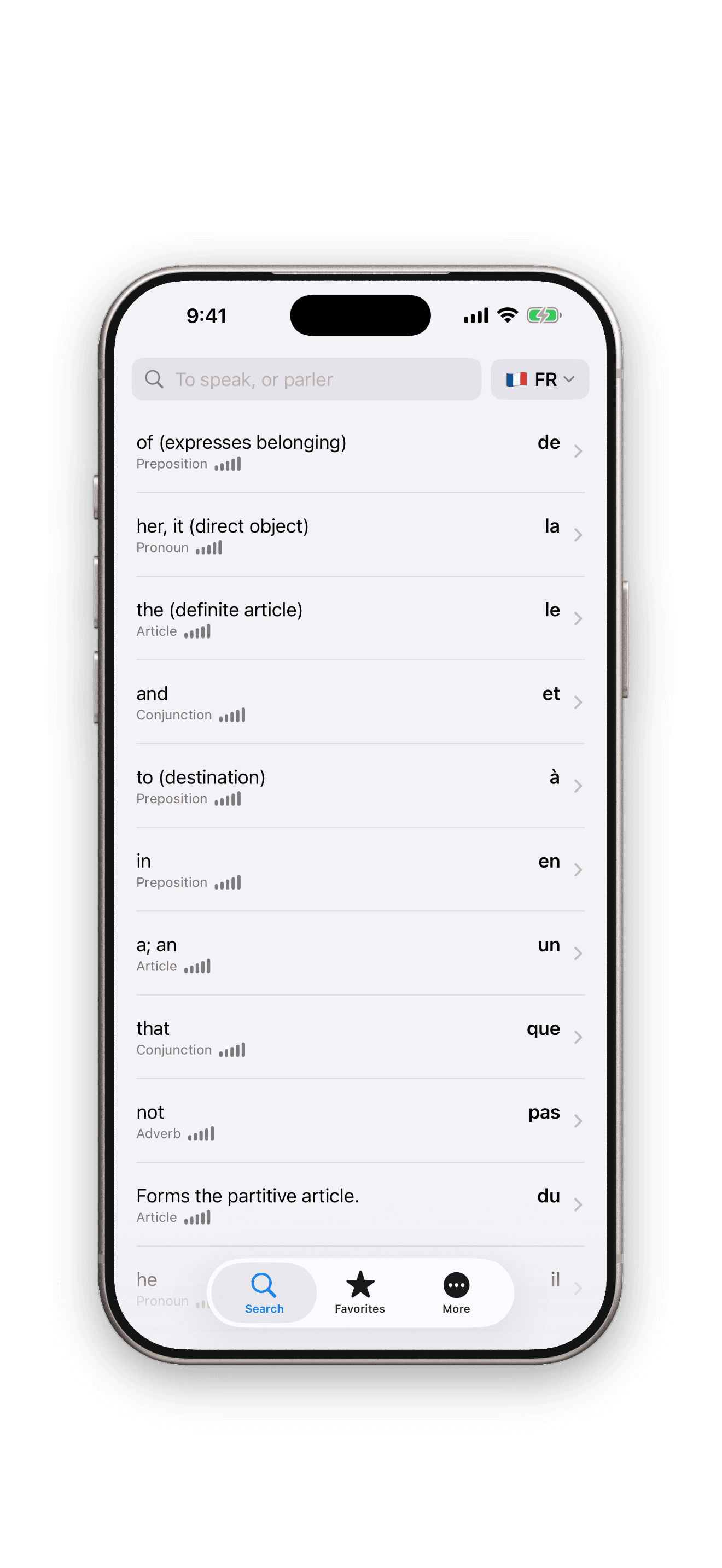
Search a French headword, conjugated form, inflected noun or adjective, or English meaning. Verbik identifies the dictionary entry, explains the match, and keeps the complete reference available offline.
Counts reflect Verbik 1.3 and may grow in later dictionary updates.
Find parler from the nous present form and see exactly why it matched.
Trace an irregular imperfect form back to the complete être entry.
Find a sourced imperfect-subjunctive form even though it sits outside the six core display tables.
Review six core conjugation tables and search sourced imperfect-subjunctive and participle-agreement forms for the exact form you encountered.
Keep imperative forms, the present participle, and the past participle with the main entry.
Search gendered nouns, plurals, adjective forms, meanings, examples, frequency, and pronunciation.
The bundled dictionary, grammar tables, and synthetic pronunciation remain available offline.
Yes. Inflected-form search connects regular and irregular French forms to the dictionary entry and labels the grammatical form that matched, including its person and tense or mood when applicable.
Yes. Every definition, grammatical form, example, and pronunciation is audited against documented sources, and frequency ordering reflects real-world usage.
Version 1.3 includes 26,917 French entries, including 4,741 verbs and 76 common phrases. Dictionary counts can increase in later updates.
Search more than 159,000 entries across six languages. No account required.
Download on the App Store